Children in Content
An attempt to add legal protections for children making content online.

I’ve been invited to help advocate for children in Oklahoma and, eventually (hopefully), the entire country. Oklahoma Representative Michell McCane reached out to me last month to discussing her efforts to pass a series of legal protections aimed at ensuring children and vulnerable populations have both the right and the ability to protect their online image and control any monetary compensation owed them for that content. Oklahoma has no such laws on the books and, honestly, that’s to be expected. Most states don’t have Children in Entertainment laws at all.
Most didn’t need to as a lot of of that was filtered through California which does have things like Coogan Laws, and carve outs for how children can be safely represented, what conditions are required for those kids, and what percentage of their pay they are entitled to factoring in day to day living and care expenses. The rise of internet and social media has reshaped the entertainment landscape and we have problems very few predicted and even fewer heeded the warnings of those who did. Content creation as a career is younger than my oldest daughter. We are still figuring out what it is to be a content creator and how we interface with businesses, platforms, and the general public.
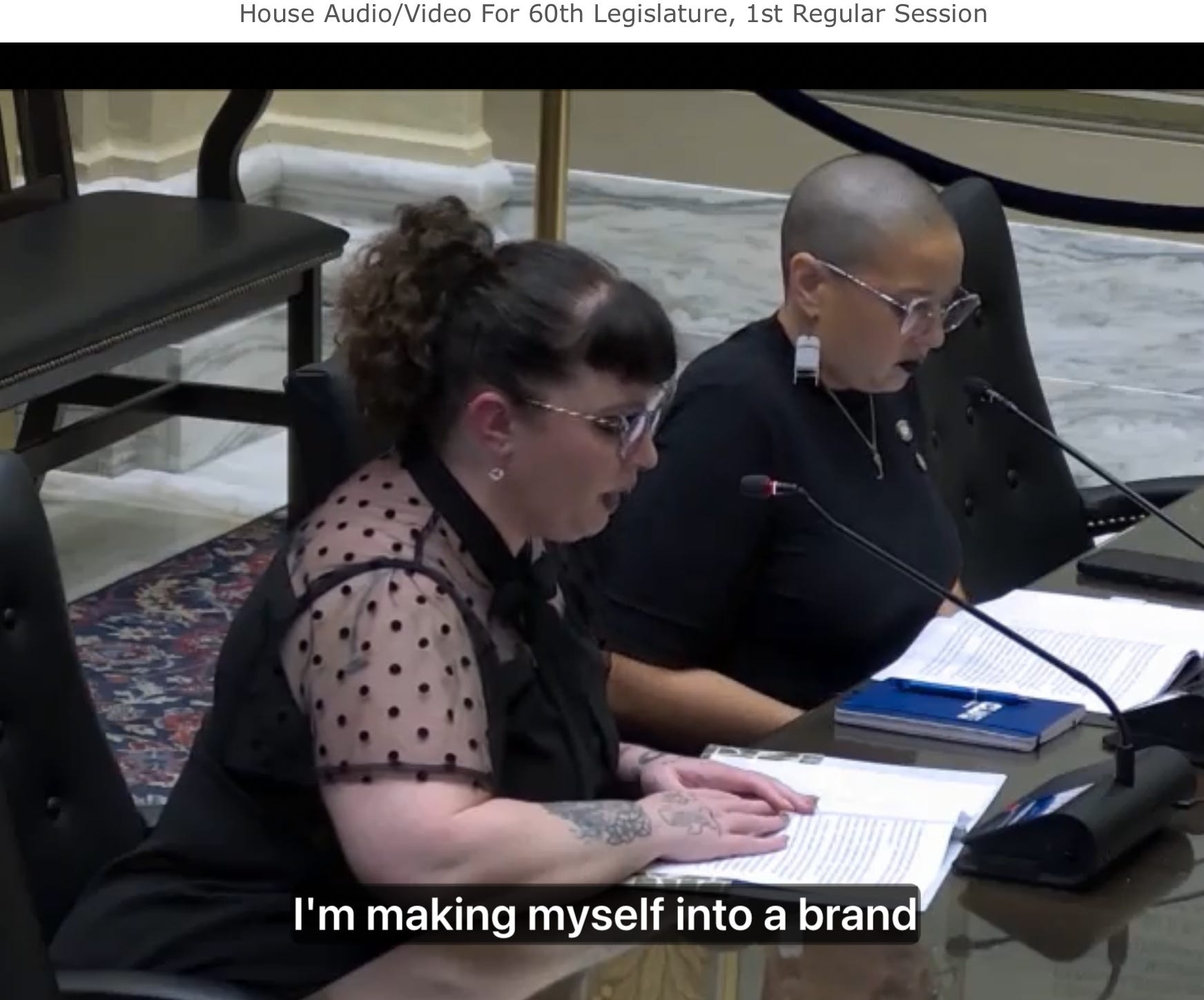
There’s a lot of work to be done and, quite frankly, couldn’t be done until now. But we don’t have to wait for more people to get hurt by the likes of Ruby Franke. What follows is my initial speech I gave before an Oklahoma Congressional Committee to launch what will hopefully become a new law in my state. If passed, this law will provide protections that if a parent does not withhold a percentage of income for the kid they featured in online or social media content, that child can legally sue their parents when they come of age.
My name is Gwenna Laithland and I have been on the forefront of a new career field. The world has never before had the convergence of technology, time, and access to allow for regular people to achieve the level of fame and notoriety without joining Stage, Screen, or the Music Industries through traditional methods of grinding, auditioning, and starving as an artist.
Now with this little box and a smidge of creativity and consistency, people can gather a following and influence culture, consumerism, and public thought. The internet has made celebrities out of slightly alternative moms from Oklahoma and guys with garages and wit in Nebraska. Regular unknown people who would have lived their lives content in their anonymity are elevated to global fame overnight.
I started my social media accounts just before the world shut down for Covid, discussing how I parented, the mistakes I made and the solutions I found. Folks responded and asked for more. I started crafting a narrative around this idea. It attracted more folks and those folks became followers and then fans.
I talked about my children and in the earliest days of content I allowed them in my videos. But the larger my accounts grew, the more that felt both in
appropriate and uncomfortable. Eventually folks started spotting me in the wild and coming up to say hi. I loved it. The connection to the people I’m impacting, the moments of joy people shared with me, the personal journeys made easier by what I said and the encouragement I offered. But that was my job to do and enjoy. Not my children’s. I didn’t like how the parasocial relationships my fans enjoyed with me expanded to my children by default.
Plus there was the matter of informed consent. My children, just toddlers when I first stated posting, were not old enough or educated enough to understand what it meant to be turned from a child to a consumable. As an adult, I understand that I’m making myself into a brand and a product. My kids couldn’t read words much less understand analytics and parasocial connection. I removed my younger children from my content, going so far as to delete videos in which they appeared to the best of my ability.
But I drew a different boundary for my oldest. With her input. She was old enough to understand a digital footprint. We’d discussed consequences and permanency. We’d how what happens today will certainly affect us when it’s time for college, career, dating, establishing a family. More so than any point in history, the record of our deeds has an excellent memory. She heard. I felt she understood. And the allure “internet famous” was appealing to a thirteen year old.
We filmed a video teasing each other, called roasting, and it went over really well. We did more videos together. Some were scripted. Some were recreations of real conversations and some were very candid moments of teenage ridiculousness and parents trying to make sense of their kids growing into their own person.
My fans, my followers craved more of that. Because while most of my content focused on how and why I made the parenting choices I did, the videos of my teenager and I enjoying a healthy, playful, supportive, stable relationship were aspirational. It was the proof in the pudding. I parent this way. And these are the fruits of my labor. My daughter enjoyed it because I shared the money we made on those videos with her, either directly via cash or indirectly by granting requests or buying higher ticket items we might not have purchased without the boost in content earnings from her presence (a la a pair of Apple AirPods and an iPad while she was in her digital art era).
Like I said though, I have been on the forefront of a new career field. It didn’t take me very long to figure out how to navigate fan encounters. As an adult I have the life experience to see a fan interaction turning on its head, going from adoring fan to unpredictable fanatic. I know when it’s becoming unsafe and I have a decent idea of when it might be necessary to call for police assistance or act in a more aggressive mode of self defense. I’m 40 years old and a woman. It’s not like I haven’t seen it before.
But my daughter didn’t have that practice, she didn’t have experience fending off unwanted advances at the age of fifteen. And when a group of excited adults swarmed and surrounded her at a cross country meet halfway across the state, she was scared. After two years of appearing in content, she opted to no longer appear in my content, giving me permission to share our stories and our entertaining encounters but only if I portrayed her as a costume character. She had no further interest in being internet famous.
She has since blossomed into a young woman and is still occasionally recognized. When we are discussing compensation for careers, most of the time we are referring to careers held by informed, consenting adults. The laws we have surrounding labor and the job market insist that expectation and compensation be clearly defined and there are laws that protect both the employer and the employed from abuses of those definitions and distinctions. But how do you define a job that is still figuring itself out?
If we are still working to define what the adult version of online content creation is, the risks you accept in taking the position, and the knowledge you need to protect yourself, what then are we doing for minors placed in the same position? What guardrails belong around children in content? What we are talking about today, compensation protections for minors in content creation, we are still talking about a barely defined and burgeoning career field. I have a background in both stage performance and content marketing. And I keep finding unintended consequences, primarily in the parasocial arena. Audiences feel entitled to the attention of the creators they love and respect.
As an adult, I can navigate that. Can you say the same of an 8 year old whose mom runs a YouTube channel unboxing toys? Do they have the wherewithal and authority to say, no I’m not currently working, leave me alone please? And what happens when the parent becomes enamored with the dopamine delivery system that is social media? Caught up in the guise of providing a better life and netting these once in a lifetime opportunities, what protects a childhood before it becomes a product to be sold, marketed, and potentially exploited?
Not every child on the internet is being exploited or turned into a consumable, on-demand product. I will stop and watch every video of a baby getting the giggles. Every time. It’s kryptonite. See also - babies eating lemons and babies playing with puppies. Those are wholesome moments of humanity. And I’ve had three babies. I know full well there was no ‘let’s do it again so we get a better smile this time.’ These are candid captures of the essence of childhood that are necessary and delightful. We are not talking about those.
We are talking about children who are handed a career. We are talking about children who work lacking an understanding of what money is, who cannot grasp compensation, contracts, money management, or fair working conditions. It is up to their parents to navigate for them. But Oklahoma, at current, lacks the support structure to protect those children’s interests when and if their parents’ judgment flags or is rooted in misunderstanding of an industry that is still in its infancy. I started wrong. I made a lot of choices that I’d make differently, now knowing what I know. And every day someone else steps to the mouth of the path I’ve already trodden. And they may or may not come to that journey with the knowledge I already possessed. Things like Coogan laws, child labor protections, the SAG-AFTRA contracts defining and protecting children in entertainment. Because that’s what this is. It’s entertainment. Education, enlightenment, and small business growth are byproducts of being a form of entertainment.
We will continue to uncover the fallout, the minutiae of online content creation, of the influencer market place, and the overall impact it has on connection, community, and capitalism. But it is our duty as both adults and concerned citizens, as representatives of a state of proud, creative, impactful people, to put in place protections for vulnerable populations. We set laws around child labor but they become unclear when the “labor” is simply playing with a toy while Mommy films with her iPhone. These laws, the ideas to protect the earning potential and promised prosperity of doing content creations as a career, even as a minor, are a first step to protecting childhoods, to ensuring that Oklahoma children continue to receive support on their journey to good, contributing, considerate resident of this state and nation. Some of us have and continue to learn it the hard way. But you have an opportunity to hear Representative McCane’s ideas and smooth those pathways for Oklahoma influentials, young, old, and middle-aged. Thank you.
I’ll keep everyone updated as this progresses through the Oklahoma State House and then on to the Senate. There’s a lot of ways for legislation to fall apart and while this is a bipartisan issues, nothing in politics is ever as simple as it could be. Representative McCane and I are in this for the long game and I hope I’ll be able to use the influence I have for good. We have to protect all kids and it’s on the adults to do it. This is net of protection I’m attempting to cast.
Thanks for reading!
GreatJob Gwenna!! 👏👏👏